

Descripción
¿Quieres tomar el control de las URL de tu sitio de WordPress? El plugin Custom Permalinks te da el poder de establecer URL únicas y personalizadas para cualquier entrada, página, etiqueta o categoría. Esto significa que puedes diseñar la estructura de tu sitio exactamente como la imaginas, en lugar de estar limitado por los ajustes predeterminados de WordPress. Cuando estableces un enlace permanente personalizado, la URL original de la entrada se redirigirá automáticamente a tu nueva URL personalizada.
Características principales
- A custom URL for any content: Set a unique permalink for any post, page, public custom post type (e.g. WooCommerce products), category, tag, or custom taxonomy term.
- Permalink structures per post type: Define a structure for each public post type from tags like
%year%,%category%, or your custom taxonomies. New content gets its permalink automatically, and you can still edit any permalink by hand. - Automatic redirects: The original URL redirects to the custom permalink, so existing links, bookmarks, and search rankings keep working.
- Multilingual: Works with WPML and Polylang, with a separate custom permalink for each translation.
- URLs in any language: Permalinks in non-Latin scripts, such as Arabic, Thai, or Cyrillic, work as you type them.
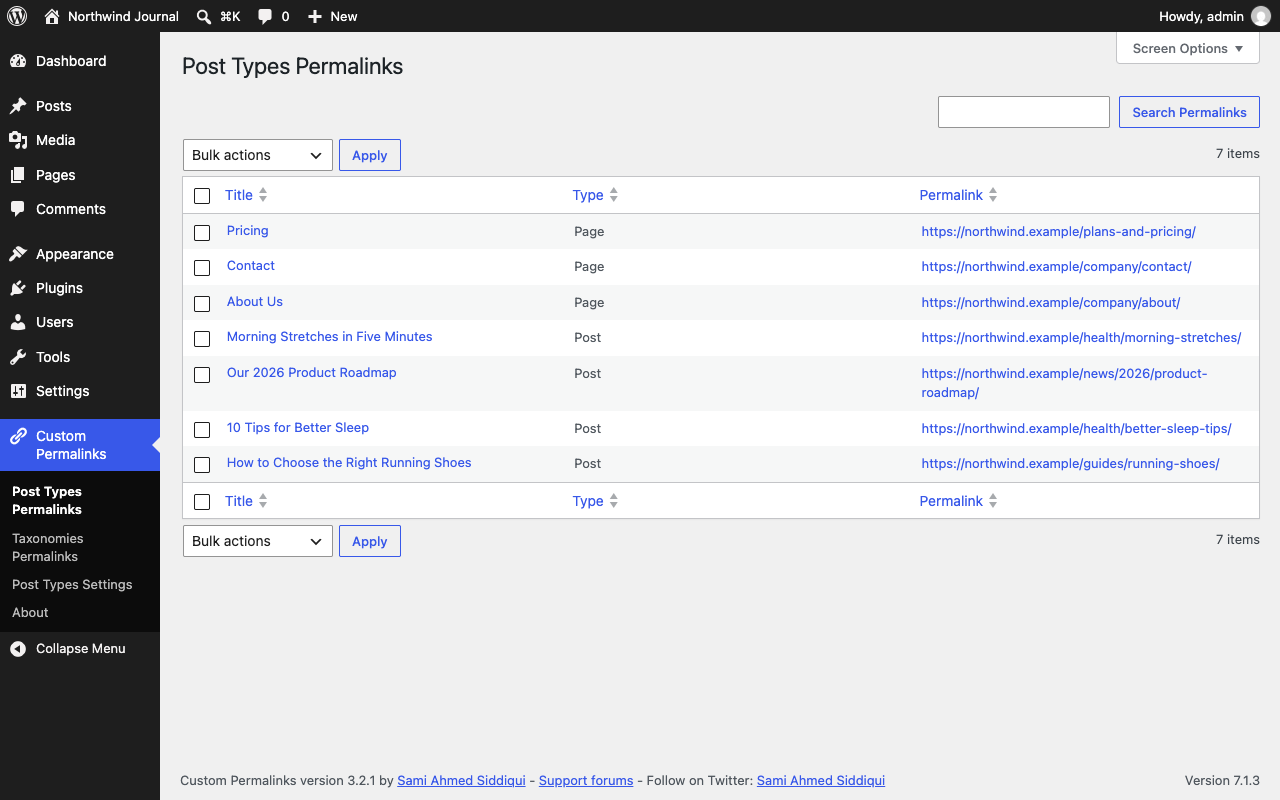
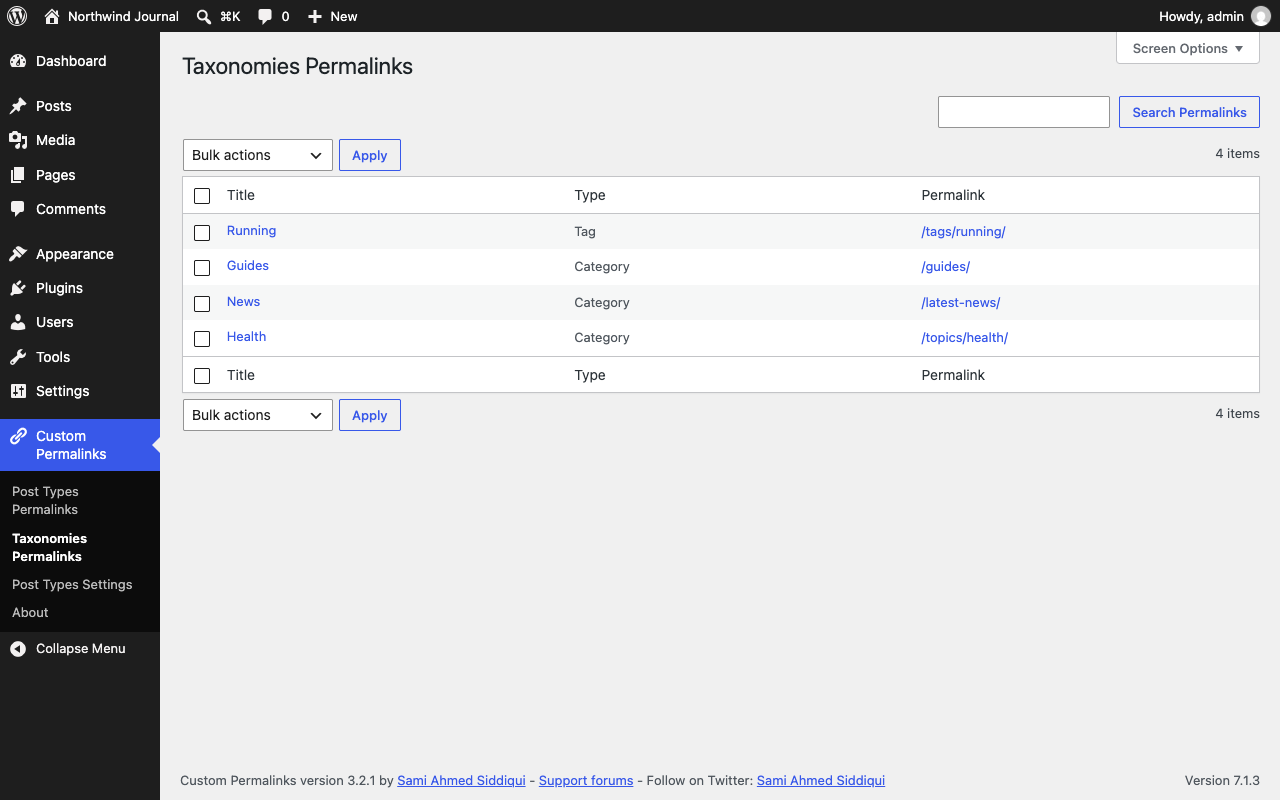
- All permalinks in one place: The Post Types Permalinks and Taxonomies Permalinks screens list every custom permalink, with search and bulk delete.
- A role for permalink managers: The Custom Permalinks Manager role lets non-administrators view and edit permalinks.
- Developer friendly: Filters and actions to add your own tags, generate permalinks in code, and control sanitizing and redirects.
Primeros pasos: ajustes del plugin
Custom Permalinks adds a Custom Permalinks menu to your WordPress dashboard:
- Post Types Permalinks and Taxonomies Permalinks: Every custom permalink on your site, with search and bulk delete.
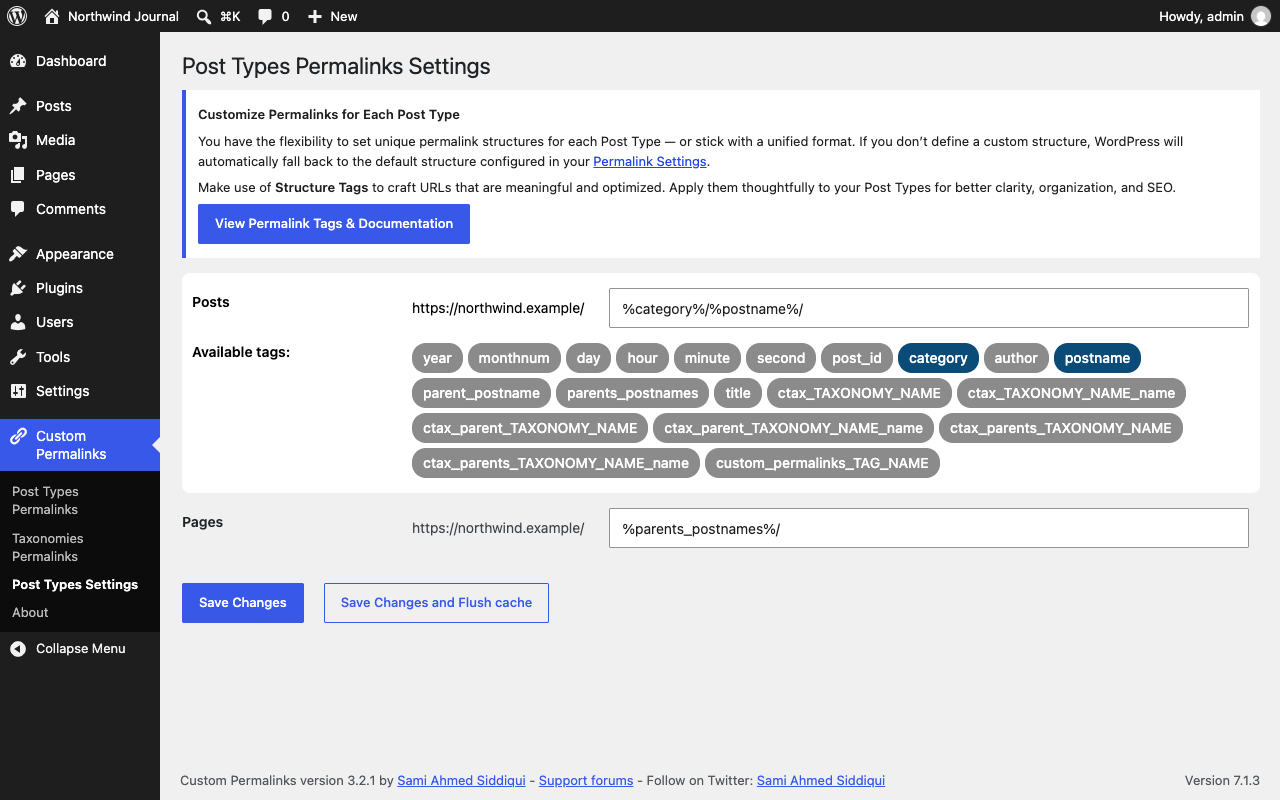
- Post Types Settings: A permalink structure for each public post type, built from the tags below. Leave a structure empty to keep WordPress’s default for that post type.
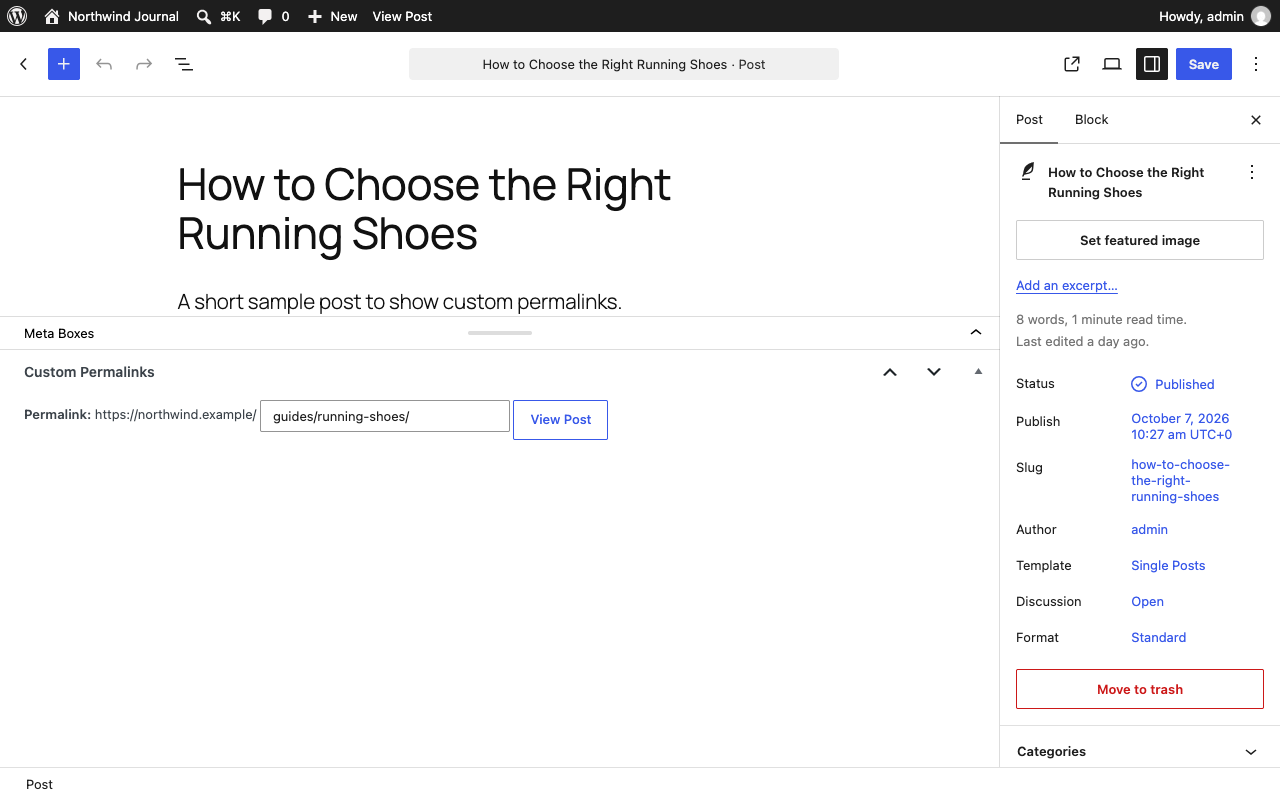
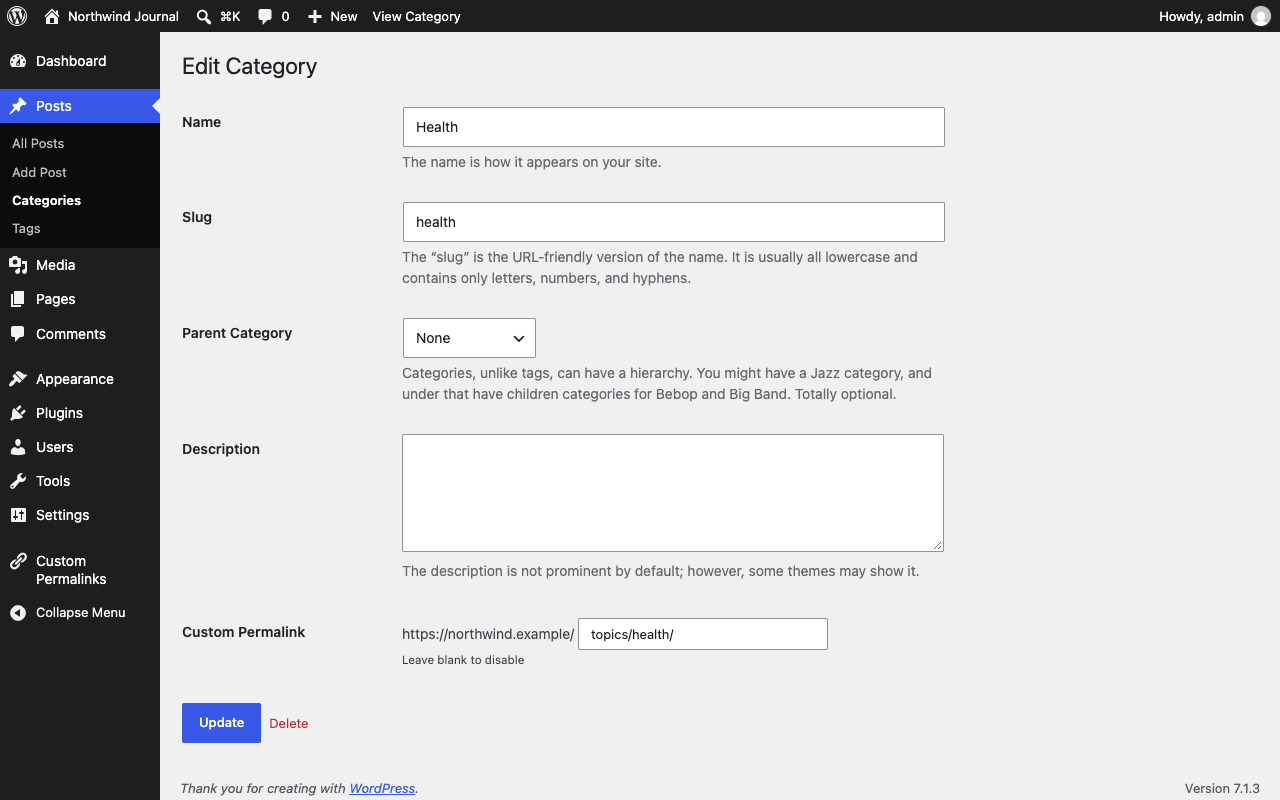
Para establecer un enlace permanente para una entrada, página, categoría o etiqueta individual, edita ese elemento y busca el campo Enlace permanente personalizado cerca de la parte superior (o en la barra lateral) de la pantalla del editor; introduce la ruta de la URL que quieras y guarda.
Etiquetas disponibles para estructuras de enlaces permanentes
Al configurar tus estructuras de enlaces permanentes personalizados, puedes usar una variedad de etiquetas que rellenarán la URL de forma dinámica. Aquí tienes un desglose de lo que está disponible:
- %year%: el año de la entrada en cuatro dígitos, p. ej.: 2025
- %monthnum%: el mes en que se publicó la entrada, en dos dígitos, p. ej.: 01
- %day%: el día en que se publicó la entrada en dos dígitos, p. ej.: 02
- %hour%: la hora del día en que se publicó la entrada, p. ej.: 15
- %minute%: el minuto de la hora en que se publicó la entrada, p. ej.: 43
- %second%: el segundo del minuto en que se publicó la entrada, p. ej.: 33
- %post_id%: el ID único de la entrada, p. ej.: 123
- %category%: A clean version of the category name (its slug). Nested sub-categories will appear as nested directories in the URL.
- %author%: The post author’s username (login name). Note that this makes usernames visible in your URLs.
- %postname%: A clean version of the post or page title (its slug). For example, «This Is A Great Post!» becomes
this-is-a-great-postin the URL. - %parent_postname%: similar a
%postname%, pero usa el slug de la página padre inmediato si se selecciona un padre. - %parents_postnames%: similar a
%postname%, pero incluye los slugs de todas las páginas padres si se seleccionan padres. - %title%: The title of the post, converted to a slug. For example, «This Is A Great Post!» becomes
this-is-a-great-post. Unlike%postname%which is set once,%title%automatically updates in the permalink if the post title changes (unless the post is published or the permalink is manually edited). - %ctax_TAXONOMY_NAME%: A clean version of a custom taxonomy’s name. Replace
TAXONOMY_NAMEwith the actual taxonomy name. - %ctax_TAXONOMY_NAME_name%: The custom taxonomy term’s name (instead of its slug). Replace
TAXONOMY_NAMEwith the actual taxonomy name. - %ctax_parent_TAXONOMY_NAME%: similar a
%ctax_TAXONOMY_NAME%, pero incluye el slug de la categoría o etiqueta padre inmediato en la URL si se selecciona un padre. - %ctax_parent_TAXONOMY_NAME_name%: similar a
%ctax_TAXONOMY_NAME_name%, pero incluye el nombre del término padre inmediato si se selecciona un padre. - %ctax_parents_TAXONOMY_NAME%: similar a
%ctax_TAXONOMY_NAME%, pero incluye los slugs de todas las categorías o etiquetas padres en la URL si se seleccionan padres. - %ctax_parents_TAXONOMY_NAME_name%: similar a
%ctax_TAXONOMY_NAME_name%, pero incluye los nombres de todos los términos padres si se seleccionan padres. - %custom_permalinks_TAG_NAME%: Developers have the flexibility to define their own custom tags (replace
_TAG_NAMEwith your desired name). To ensure these tags resolve to the correct permalinks, simply apply thecustom_permalinks_post_permalink_tagfilter.
Nota importante: para las entradas nuevas, Custom Permalinks seguirá actualizando el enlace permanente mientras la entrada esté en modo borrador, suponiendo que se haya definido una estructura en los ajustes del plugin. Una vez que la entrada se publique o su enlace permanente se actualice manualmente, el plugin dejará de realizar actualizaciones automáticas para esa entrada específica.
Custom Permalinks: ajuste fino con filtros
Custom Permalinks ofrece una gama de filtros que permiten a los desarrolladores controlar con precisión su comportamiento. Puedes explorar todos los filtros disponibles, completos con ejemplos de fragmentos de código, en nuestro repositorio de GitHub.
Para obtener ayuda:
- Usuarios premium: si necesitas ayuda para implementar estos filtros, no dudes en ponerte en contacto con nosotros a través de nuestro soporte de contacto premium.
- Otros usuarios: también puedes ponerte en contacto directamente con el autor del plugin a través de LinkedIn.
¿Necesitas ayuda o has encontrado un error?
- Soporte: para soporte por correo electrónico personalizado, considera adquirir Custom Permalinks Premium. Aunque se puede proporcionar algo de soporte básico en los foros de WordPress.org, el soporte por correo electrónico tiene prioridad para los usuarios premium.
- Informes de errores: si encuentras un error, infórmalo en GitHub. Asegúrate de proporcionar información completa para reproducir el problema. GitHub es para informes de errores, no para preguntas generales de soporte.
Si experimentas algún problema que rompa el sitio después de actualizar, infórmalo en el foro de WordPress o en GitHub con información detallada. Siempre puedes volver a una versión anterior descargándola desde https://wordpress.org/plugins/custom-permalinks/advanced/.
Capturas
Instalación
Tienes dos formas de instalar Custom Permalinks:
Desde dentro de WordPress
- Go to Plugins > Add New in your WordPress dashboard.
- Busca «Custom Permalinks».
- Haz clic en «Instalar ahora» y luego en «Activar» el plugin desde tu página de Plugins.
Manual a través de FTP
- Descarga la carpeta
custom-permalinks. - Sube la carpeta
custom-permalinksa tu directorio/wp-content/plugins/. - Activa Custom Permalinks a través del menú «Plugins» en tu panel de control de WordPress.
FAQ
-
¿Qué ocurre con la URL original cuando establezco un enlace permanente personalizado?
-
Custom Permalinks redirige automáticamente la URL original (predeterminada) a tu nuevo enlace permanente personalizado, por lo que los enlaces existentes, los marcadores y el posicionamiento en los motores de búsqueda siguen funcionando.
-
¿Afectará esto al SEO de mi sitio?
-
No debería perjudicarlo, ya que la URL original redirige a la nueva, los motores de búsqueda y los enlaces entrantes existentes siguen resolviéndose correctamente. Usar enlaces permanentes personalizados limpios y descriptivos también puede hacer que tus URL sean más legibles, lo que generalmente es bueno para el SEO.
-
Sí. Custom Permalinks es compatible con entradas, páginas, cualquier tipo de entrada personalizado público, y categorías o etiquetas (y otros términos de taxonomía personalizados).
-
¿Funciona con tipos de entrada personalizados, como los productos de WooCommerce?
-
Yes. You can set an individual custom permalink on any public custom post type, or define an automatic permalink structure for the entire post type from Custom Permalinks > Post Types Settings.
-
¿Es Custom Permalinks compatible con WPML o Polylang?
-
Sí, el plugin es compatible tanto con WPML como con Polylang, incluyendo entradas traducidas que cada una tiene su propio enlace permanente personalizado.
-
Can I use non-English characters in my permalinks?
-
Yes. Permalinks in non-Latin scripts, such as Arabic, Thai, Cyrillic, or Chinese, work as you type them. Browsers request these URLs percent-encoded, and Custom Permalinks matches them either way.
-
Where do the plugin’s translations come from?
-
From translate.wordpress.org. WordPress downloads them automatically for your site’s language. If the plugin shows in English on a translated site, update the translations from Dashboard > Updates. You can also help translate it there.
-
¿Puedo permitir que un no administrador gestione los enlaces permanentes?
-
Sí. El plugin añade un rol dedicado de gestor de enlaces permanentes personalizados (y las capacidades correspondientes) para que puedas permitir que usuarios específicos no administradores vean o editen los enlaces permanentes sin darles acceso completo de administrador.
-
¿Puedo usar letras con acentos, mayúsculas o guiones adicionales en mis enlaces permanentes?
-
Por defecto, Custom Permalinks sanitiza los enlaces permanentes de la misma forma que el núcleo de WordPress (minúsculas, sin acentos, sin guiones repetidos). Los desarrolladores pueden eliminar estas restricciones con los filtros
custom_permalinks_allow_accents,custom_permalinks_allow_capsycustom_permalinks_redundant_hyphens. Consulta la sección de personalización avanzada y filtros en GitHub. -
La vista previa del frontend de un constructor de páginas (Cornerstone, etc.) se rompe o pierde su modo de edición en páginas con un enlace permanente personalizado
-
Algunos constructores de páginas cargan su vista previa en vivo o del frontend en un iframe usando una solicitud
POSTque lleva valores especiales que el constructor necesita (por ejemplo,cs_preview_timede Cornerstone). Si esa página también tiene un enlace permanente personalizado, Custom Permalinks puede redirigir la solicitud, y como las redirecciones se siguen comoGET, los datosPOSTdel constructor se pierden y la vista previa se rompe.Puedes indicar a Custom Permalinks que omita su redirección para esa solicitud con el filtro
custom_permalinks_avoid_redirect, añadido a tu tema o a un plugin específico del sitio:add_filter( 'custom_permalinks_avoid_redirect', function( $permalink ) { if ( isset( $_POST['cs_preview_time'] ) ) { // Adjust to match the field your builder sends. return true; } return false; } );Consulta la sección de personalización avanzada y filtros en GitHub para este y otros filtros disponibles.
-
¿Qué ocurre con mis enlaces permanentes personalizados si desactivo o desinstalo el plugin?
-
Desactivar el plugin mantiene todos tus enlaces permanentes personalizados guardados en la base de datos; reactivarlo los restaura inmediatamente. Desinstalar (eliminar) el plugin elimina permanentemente todos los enlaces permanentes personalizados guardados y los ajustes del plugin, y tus URL volverán a la estructura de enlaces permanentes predeterminada de WordPress.
-
Mi enlace permanente personalizado no se guarda o la página no redirige; ¿qué debo comprobar?
-
- Make sure Settings > Permalinks isn’t set to «Plain».
- Confirma que ningún otro plugin de SEO o redirección (Yoast, RankMath, Redirection, etc.) tenga una regla conflictiva para la misma URL.
- Comprueba que el enlace permanente no esté ya siendo usado por otra entrada; Custom Permalinks no aplicará una URL duplicada.
- ¿Sigues atascado? Consulta «¿Necesitas ayuda o has encontrado un error?» más arriba, o ponte en contacto a través de GitHub o del soporte premium.
Reseñas


Colaboradores y desarrolladores
«Custom Permalinks» es un software de código abierto. Las siguientes personas han colaborado con este plugin.
Colaboradores
«Custom Permalinks» está traducido en 19 idiomas. Gracias a los traductores por sus contribuciones.
Traduce «Custom Permalinks» a tu idioma.
¿Interesado en el desarrollo?
Revisa el código , echa un vistazo al repositorio SVN o suscríbete al registro de desarrollo por RSS.
Registro de cambios
3.3.3 – Oct 13, 2026
- Bug:
- Fixed an infinite redirect loop on percent-encoded custom permalinks without a trailing slash (e.g. Japanese), a regression in 3.3.0.
3.3.2 – Oct 11, 2026
- Bug:
- Fixed custom permalinks in non-Latin scripts returning a 404 (e.g. Persian) when a shorter custom permalink matched the start of the URL (e.g. a
product/page forproduct/سلام/), a regression in 3.3.0. - Fixed custom permalinks in non-Latin scripts not loading with an endpoint appended (e.g.
/سلام/feed/).
- Fixed custom permalinks in non-Latin scripts returning a 404 (e.g. Persian) when a shorter custom permalink matched the start of the URL (e.g. a
3.3.1 – Oct 8, 2026
- Bug:
- Fixed the editor’s View Post and preview links not updating, or the wrong links being updated, after saving a custom permalink when the post’s previous URL contained characters such as
?,+or((e.g.?p=123for drafts). - Hardened the editor script to only update links with an http(s) URL on the site’s own domain.
- Fixed the editor’s View Post and preview links not updating, or the wrong links being updated, after saving a custom permalink when the post’s previous URL contained characters such as
- Accessibility:
- Added labels for screen readers to the checkboxes in Post Types Permalinks and Taxonomies Permalinks, the structure fields in Post Types Settings, and the Custom Permalink field on category, tag, and term screens.
- Raised the text contrast of the structure tags in Post Types Settings and of the plugin descriptions on the About screen, and underlined links in its text.
3.3.0 – Oct 8, 2026
- Changes to be aware of:
- Requires WordPress 5.9 and PHP 7.4 or later, the oldest versions the plugin is now tested on. Sites on older versions keep 3.2.1.
- Translations now come from translate.wordpress.org instead of files bundled with the plugin. It covers every bundled language and adds Serbian. Sites that installed the plugin outside wordpress.org, or turned off automatic translation updates, show English until the language pack is installed from Dashboard Updates.
- WPML translations now always resolve to their own custom permalink. Previously they returned another language’s custom permalink depending on the active (admin) language, which listed wrong URLs in Post Types Permalinks and in SEO plugins’ indexables and XML sitemaps (e.g. Yoast SEO).
%ctax_parents_TAXONOMY_NAME_name%now uses the parent terms’ names, as documented, instead of their slugs. Permalinks generated from now on change where a parent term’s name differs from its slug; saved permalinks are not changed.
- Redirects and URLs:
- Fixed custom permalinks in non-Latin scripts (e.g. Thai, Arabic, Cyrillic) returning a 404 or redirecting in an infinite loop, as the browser requests them percent-encoded while they are saved unencoded (or vice versa, depending on the site language).
- Fixed the trailing-slash redirect and the redirect to the custom permalink dropping the page number (e.g.
/news/page/2redirected to/news/instead of/news/page/2/). - Added the
custom_permalinks_disable_remove_page_numberfilter to keep the/page/{number}segment in the requested URL, for custom archive pages whose pagination doesn’t advance. - Fixed the query string being corrupted (e.g.
foo=barbecamehttp://foo=bar) after a custom permalink was resolved. - Fixed comment links on paginated comments (e.g.
/my-post/comment-page-2/) not following the custom permalink’s trailing slash, so a custom permalink without a trailing slash no longer gets comment URLs with one, and vice versa.
- WPML and Polylang:
- Fixed the WPML language switcher linking back to the current language instead of the translation when languages are in directories (e.g.
/en/,/de/) and the translation uses the same custom permalink. - Fixed WPML language directories that differ from the language code (e.g.
/de-de/forde, as in WPML 5.0) not being repaired when duplicated, and the default language getting its directory added to a permalink when «hide the default language directory» is on. - Fixed English custom permalinks not being lowercased and cleaned of special characters with WPML 5.0’s region-based language codes (e.g.
en-us). - Fixed Polylang translations sharing the same custom permalink (e.g.
/en/technologyand/zh/technology) redirecting to the other language when the translation’s stored language was missing or out of date.
- Fixed the WPML language switcher linking back to the current language instead of the translation when languages are in directories (e.g.
- Admin screens:
- Fixed Post Types and Taxonomies Permalinks pagination showing the first page’s results on every page, ignoring sorting and search, when a persistent object cache (e.g. Redis or Memcached) is enabled. The lists now also refresh right after a permalink is added, changed or deleted.
- Fixed bulk delete and search in Post Types and Taxonomies Permalinks failing with a «headers already sent» warning instead of redirecting.
- Fixed short titles and permalinks being padded with leading spaces in the Post Types and Taxonomies Permalinks lists.
- Fixed every post of a type showing and saving the same custom permalink when a theme or plugin runs a custom loop in the admin without resetting the global post.
- Fixed the original permalink showing as the custom permalink in the edit screen’s permalink box and in the block editor, and being compared against when saving a post or term.
- Fixed a fatal error on WordPress 5.9 and 6.0 when saving the Post Types Permalinks settings with the cache flush option, as
wp_cache_flush_group()needs WordPress 6.1. Object caches that can’t flush a single group now get a full cache flush. - Fixed the «Custom Permalinks Manager» role name not being translatable.
- Fixed Post Types Settings showing the WordPress address instead of the site address before each structure, which is wrong when WordPress is installed in a subdirectory.
- Compatibility:
- Fixed WooCommerce notices about accessing order data directly on order screens, as the permalink form read post fields from the
WC_Orderobject. - Fixed posts updated by WP All Import being handled as new posts, which turned permalink regeneration back on and could replace their custom permalink with the post type’s structure.
- Fixed the
seems_utf8()deprecation notice on WordPress 6.9 and later.
- Fixed WooCommerce notices about accessing order data directly on order screens, as the permalink form read post fields from the
Earlier versions
- For the changelog of earlier versions, please refer to the separate changelog.txt file.